Lingofable vs LingQ: Same Philosophy, Different Execution
LingQ and Lingofable share the same reading-first philosophy. The difference is who supplies the content, and that decides which one keeps you reading.
By Simon Ilincev, founder of Lingofable · Last updated September 18, 2026
Of all the comparisons in this series, this is the one where I have the least philosophical disagreement to offer. Steve Kaufmann, LingQ’s co-founder, has spent some twenty years telling people to stop drilling and start reading and listening in volume, and he’s simply right; my own ~2,400 hours of Chinese were mostly won exactly that way. And since I’m the developer of Lingofable, an app built on the very same comprehensible-input philosophy, this post mostly comes down to one question, and a fairly narrow one at that: where does your content come from?
In short
LingQ is a toolbox for studying content you find or import, in 50+ languages. If you already know what you want to read, it’s excellent. Lingofable is for the (very common) opposite situation: you’re learning Spanish, and figuring out what you can actually read eats more energy than the reading itself. Lingofable puts the stories at your level so that the hunt disappears.
The two apps at a glance
| Lingofable | LingQ | |
|---|---|---|
| Languages | Spanish (more on the way) | 50+ (many in beta) |
| Where content comes from | A 4,200+ story library, written to CEFR levels | You find or import it; community library (copyright status of shared uploads varies) |
| Difficulty labels | Written to a target CEFR level | Set by whoever uploaded the lesson |
| Audio | Narration on every story | Native audio on official lessons, robotic TTS elsewhere |
| Progress tracking | CEFR level + known words | Known-words count |
| Import your own content | Not supported (considering it!) | Strong (browser extension, ebooks, Whisper) |
| Free tier | Free fables, no account needed | 20 saved words total, then paywalled |
| Price | $6.99/mo or $44.99/yr | Expensive: $14.99/mo or $119.99/yr; AI tier $269.99/yr |
Prices and features checked September 18, 2026.
Bring your own content — or don’t
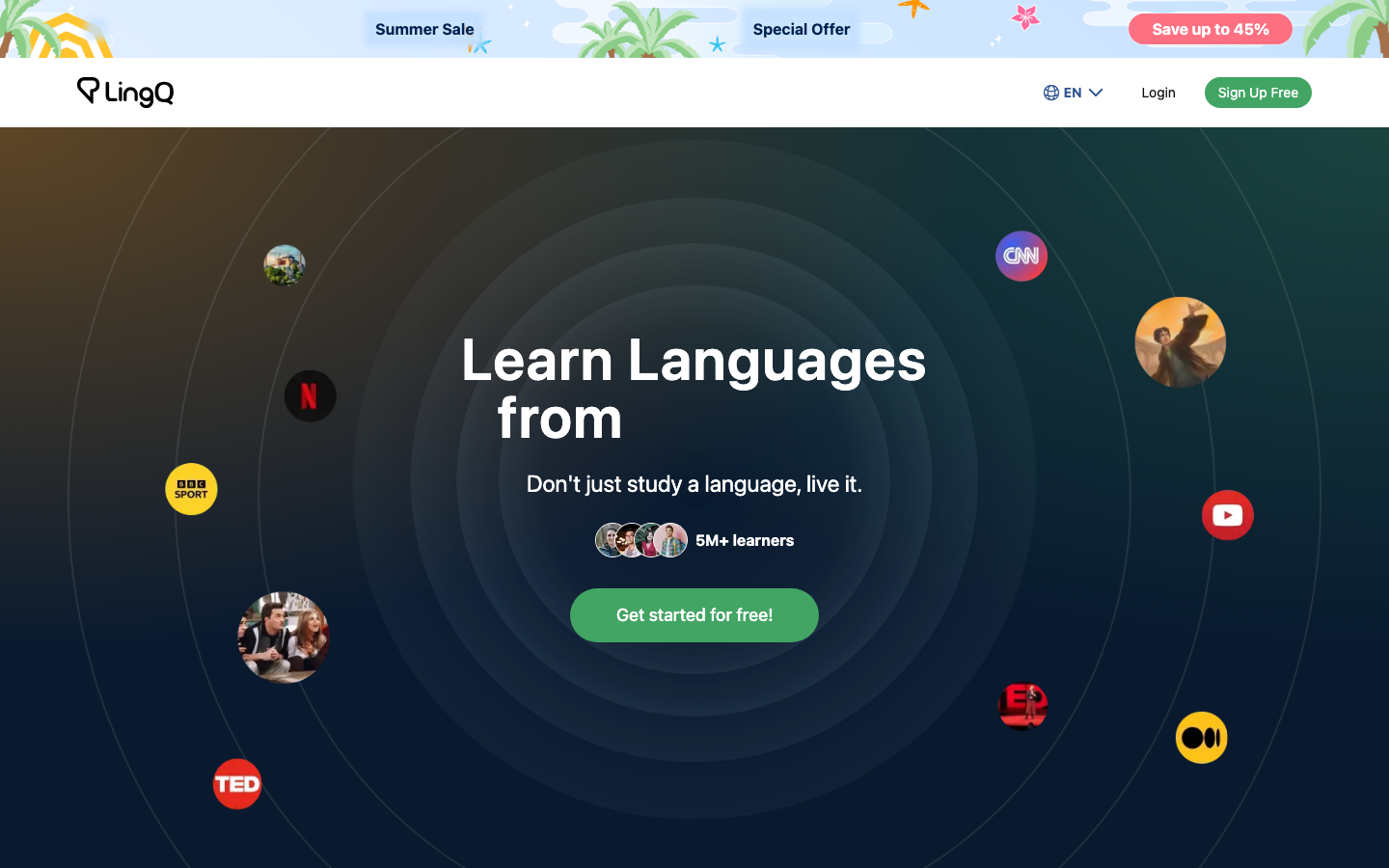
LingQ’s superpower is ingestion. Browser articles, YouTube videos, podcasts, DRM-free ebooks — if you can get text or audio into the app, it becomes a lesson with clickable words and spaced repetition, and their Whisper integration will even transcribe raw audio for you. I don’t know of anything else that does this quite as well, and I’ll say upfront that we don’t do it at all. (Yet! I’m graduating soon, and that entails more time to build.)
The catch is that ingestion presumes you have something worth ingesting. At the intermediate stage, most native content is too hard and most learner content is too boring. I spent a good year of my Chinese stuck in exactly that gap, and it’s where a huge share of self-taught learners give up. LingQ’s community library is large, but difficulty tags are set by whoever uploaded the text, so treat them as rough guesses, and the 20-saved-words free limit means you generally hit the paywall somewhere in your first article. For a method whose whole premise is volume, that’s a bit of an unfortunate introduction.
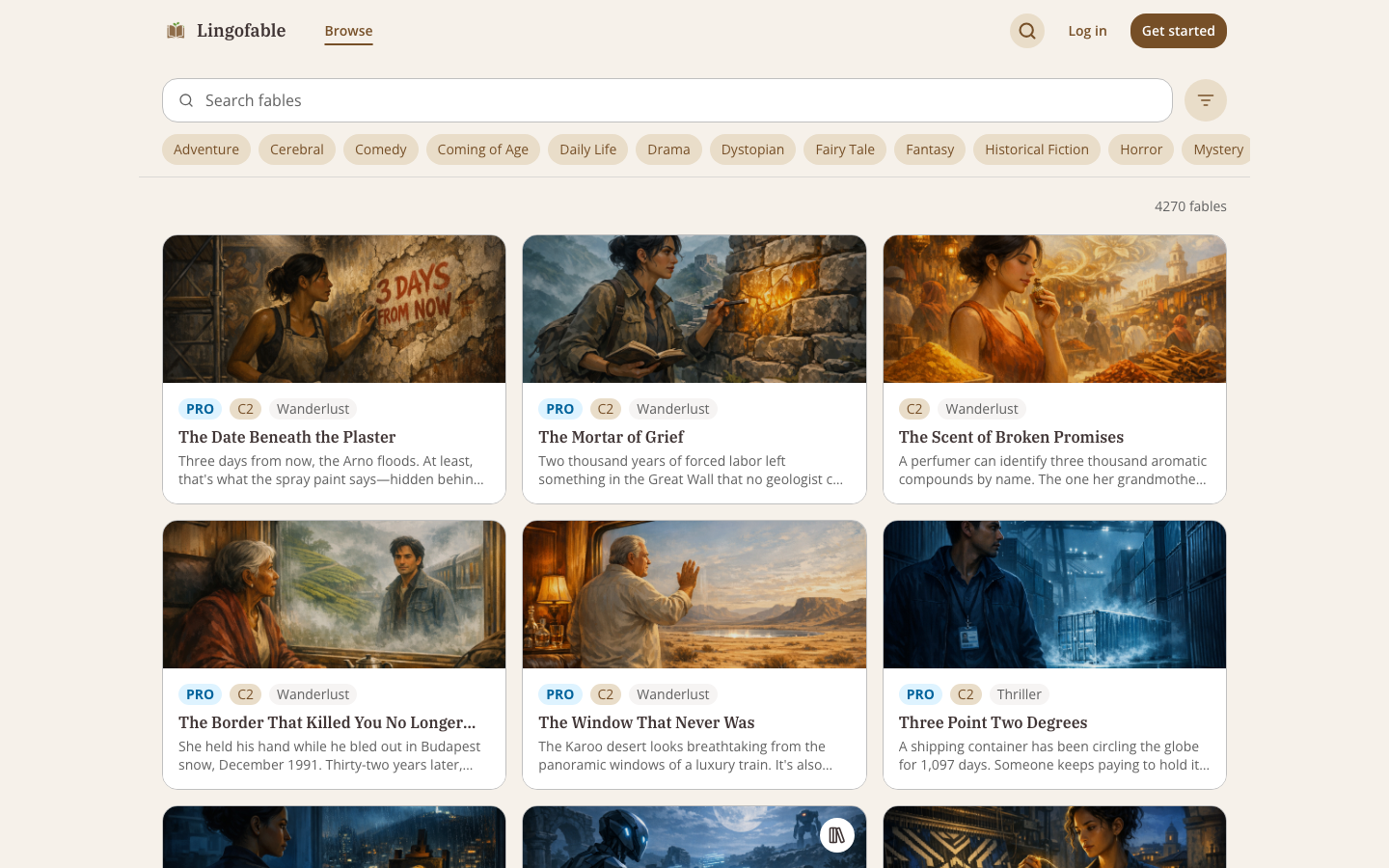
Lingofable approaches the problem from the other end. A placement test estimates your level, and every fable in the library (4,200+ Spanish stories and counting, from fantasy series to Reddit-style confession threads) was written to a specific CEFR band, so an A2 story reads like an actual A2 story. Each one comes with narration and tap-to-translate on every word and sentence, and behind the scenes we keep a running ledger of which words you personally know, so what gets recommended comes from statistics about your actual vocabulary rather than a level label alone. The “what do I read next” question stops being a research project, which, if my own experience is anything to go by, is half the battle.
Why level accuracy matters so much
The reason I harp on about level accuracy: Krashen’s input hypothesis holds that you acquire language from input you mostly understand, and vocabulary researchers like Paul Nation put the comfortable-reading threshold at knowing roughly 95–98% of the words on the page. Content in that band gives you reading gain; anything much below it, reading pain, as the lookups get so frequent that you’re effectively studying in English rather than Spanish. LingQ leaves that calibration entirely to you: open a lesson, check the unknown-word percentage, close it, try another. Power users get quite good at this. Everyone else tends to churn, and the complaints that dominate LingQ reviews are about the dated, clunky interface and the price, with “I never figured out what to read” not far behind.
I built the calibration into the product instead. Lingofable only counts a word as known after you’ve encountered it about a dozen times, and uses that ledger to serve stories inside your comprehension band. When your vocabulary crosses a CEFR boundary, your level updates and the stories grow harder with you. (Partly in response to that first complaint, Lingofable was also built design-first; my cofounder and I talked through how on this podcast episode, if you’re curious.)
Where LingQ wins
Fifty-plus languages against our one. Nineteen years of iteration, and a power-user community with people holding 2,000-day streaks and six-figure known-word counts who read entire novels inside the app; I have genuine affection for that crowd. Their SRS review system is considerably deeper than our vocabulary manager, though we do let you export your words, example sentences included, straight into Anki. And if your workflow is “study my own ebooks and podcasts,” LingQ is simply the right tool here.
Where I’d push back is the price of entry: $119.99 a year for Premium, $269.99 for the top tier, and a free plan that stops being useful within about ten minutes. Lingofable Pro is $44.99 a year, and our free tier is complete fables you can read without so much as an account.
Where I land
Most people reading a Spanish-focused comparison are somewhere between A1 and B2 with a reading habit that keeps breaking, and for that reader my recommendation is to start with us. The “what do I read next” question disappears, every story comes narrated (on LingQ, the audio is only as good as whatever you imported), and frankly our library is more fun: Reddit-style threads, multi-part series, stories written to be read rather than studied. We can even serve the Anki-pipeline crowd, since your vocabulary exports with example sentences included. LingQ stays the obvious pick for other languages and for B2+ readers with their own reading lists; and when you eventually graduate to García Márquez in the original, it’s a lovely place to read him.
Frequently asked questions
Is Lingofable a LingQ alternative?
For Spanish learners, I would say yes, and a strong one: Lingofable supplies an original leveled library, personalized to your interests and measured level, with narration on every story. LingQ remains the better tool when your content already exists and you just want tooling to study it, or when your language is not Spanish.
Which is cheaper, LingQ or Lingofable?
LingQ Premium is $14.99/month or $119.99/year, with a Premium Plus tier at $269.99/year. Lingofable Pro is $6.99/month or $44.99/year, roughly a 2.5x difference at the annual tier.
Does Lingofable support languages other than Spanish?
Not yet — Spanish only, with more planned. LingQ supports 50+ languages, and if your target language is not Spanish, that rather settles the comparison by itself. For now ;)
Can I use either app for free?
LingQ’s free plan allows 20 saved words total before requiring Premium, so treat it as a demo. Lingofable’s free tier includes complete fables with tap-to-translate and audio previews, no account needed.
Can Lingofable import my own books or articles?
No, and if importing is core to your workflow, that answers the whole comparison: LingQ is best-in-class at turning ebooks, articles, YouTube videos, and podcasts into lessons, while Lingofable serves its own library only.