Lingofable vs Duolingo: An Honest Comparison
Duolingo is a great game, but I’d hesitate to call it a Spanish course. Where drills stall out, what the research shows, and what I’d use instead.
By Simon Ilincev, founder of Lingofable · Last updated September 18, 2026
I’ve spent years on the learner side of language apps. By the time I passed the HSK 6 I’d logged around 2,400 hours of Chinese (quite a bit more since), and a decent chunk of the early ones went to apps that felt like progress but weren’t. This post is mostly me trying to save you from repeating that particular mistake in Spanish.
My somewhat unpopular position is that Duolingo is best understood as a games company. This isn’t meant as an insult, as the streaks, leagues, and the owl that guilts you at 11pm are genuinely world-class game design, and their shareholder letters (which lead with daily active users, not learner outcomes) suggest the company sees itself much the same way. The trouble is that a game about Spanish and actually acquiring Spanish part ways surprisingly early. Once you can limp through a simple sentence (or even before), I’d argue you’re better served nearly anywhere else.
In short
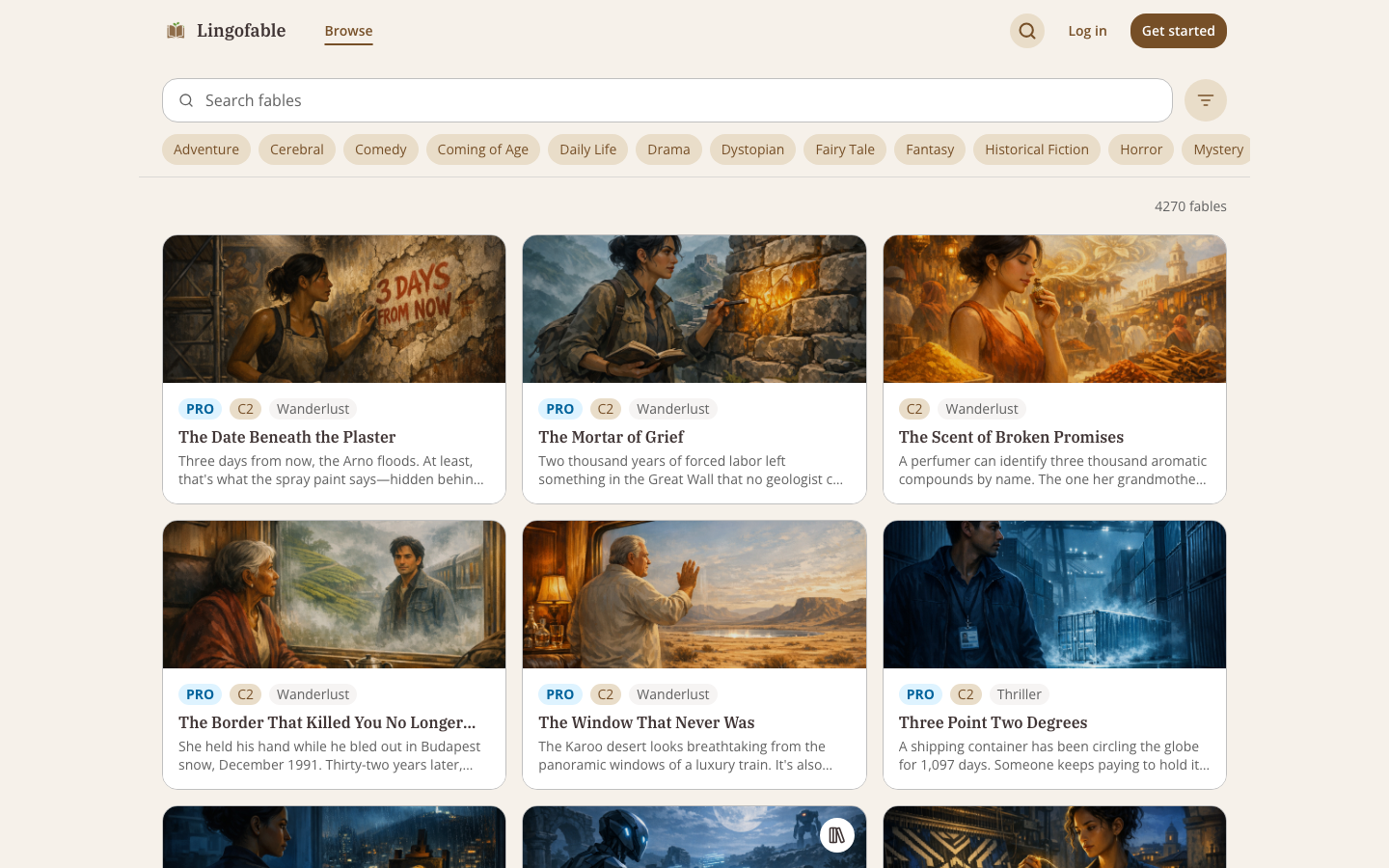
I wouldn’t recommend Duolingo much past your very first weeks, and honestly, even for those there are better free tools (more on that below). As soon as simple sentences start making some sense, the fastest gains come from real input at your level: reading and listening to material you mostly understand. That’s the stage Lingofable was built for.
What the numbers say
Duolingo’s own commissioned efficacy studies place learners who complete the A2 sections of the Spanish course at around A2 to early B1 in reading and listening, with speaking and writing behind that. And that’s the best case they publish: it covers only the small minority of users who finish said sections at all, and lower-intermediate comprehension is what those years of daily lessons buy you. What’s more, a CHI-published study of the app’s gamification found users with streaks in the hundreds of days who weren’t sure their Spanish had improved; one 600-day user said exactly that. Hundreds of days of “I did my lesson” without ever quite getting to “I understood something in Spanish.” That gap is worth taking seriously before you’re 600 days in yourself.
| Lingofable | Duolingo | |
|---|---|---|
| Core activity | Reading full stories with audio | Gamified lessons: drills, matching, short dialogues |
| Languages | Spanish only | 40+ languages |
| Longest input you read | Complete multi-page stories and series | Sentence-length; Stories run 1–2 minutes |
| Personalization | Interests + measured CEFR level | Fixed course path, same for everyone |
| Progress metric | CEFR level + known-word count | Streaks, XP, leagues |
| Free tier | Free fables, no account needed | Full courses free (ads + Energy limits) |
| Paid price (US) | Pro $44.99/yr | Super ~$83.99/yr; Max ~$168/yr |
Prices and features checked September 18, 2026.
Why drills stall out
The underlying issue is one of volume. Krashen’s comprehensible input hypothesis (the idea that you acquire language from input you mostly understand, in quantity) has held up remarkably well over the decades, and it matches my own experience: what finally moved my Chinese wasn’t any app’s course path but months of reading books slightly too easy for me.
And volume is precisely what a drill app can’t structurally provide. Duolingo evidently knows this (hence Stories and DuoRadio), but Stories exist in only six courses, run a minute or two each, and sit at fixed points along the path. They’re real input, just in homeopathic doses.
What I’d use for the from-zero weeks instead
Even for the true-beginner stage, where Duolingo is at its best, there are frankly better (and equally free) options. If I were starting Spanish today, I’d work through Language Transfer’s Complete Spanish, a free audio course that actually explains how the language works instead of having you tap cute word tiles, alongside a starter frequency deck in Anki for the first 500 or so words, with SpanishDict on hand for conjugations. A few weeks of that and simple sentences stop being noise, at which point you’ve reached the handoff. (A patient tutor accelerates all of this considerably, if it’s within budget.)
To be fair to the owl (or perhaps I’m just trying to protect my family): the free tier really is a full curriculum, the habit scaffolding genuinely helps people who’ve never stuck with anything for 30 days, and they teach 40 languages to our one. If the streak is the only thing keeping you in contact with Spanish at all, keep it. But I challenge you to demote it to warm-up duty for a week, and see how much faster you actually learn.
All in all
Use whatever gets you through the first weeks (though I’d sooner point you at Language Transfer and a frequency deck than at the owl), and then get yourself reading real Spanish at your level as early as you can. Lingofable’s placement test takes a few minutes and tells you where you stand on the A0–C2 scale; do take it even if you never pay us a cent, as knowing your actual level changes what you choose to read everywhere, not just with us.
I sincerely hope this saves you some of the hours I lost to the wrong apps. And if your streak is at 600 days and your Spanish is thriving regardless — genuinely, tell me! The feedback button in our app goes straight to me, and I’d love to be proven wrong.
Frequently asked questions
How far does Duolingo actually get you in Spanish?
Most users never finish the course, and by Duolingo’s own commissioned efficacy studies, those who complete the A2 sections land around A2 to early B1 in reading and listening, with speaking behind that. The course content now technically reaches B2, but content level and learner attainment are quite different things.
Does Duolingo have stories too?
It does — Stories are short interactive dialogues available in six courses (Spanish included), plus DuoRadio for audio. They run a minute or two, sit at fixed difficulty on the course path, and can’t be chosen by interest. Real input, just nowhere near the volume that moves you forward at the intermediate stage.
What is the Duolingo plateau?
The common experience of holding a long streak, finishing beginner material, and still freezing when someone speaks at normal speed. Breaking it takes large amounts of comprehensible input — reading and listening near your level — which drill-format apps provide in very small doses. I hit the same wall in Chinese; extensive reading is what got me through.
Should a complete beginner use Duolingo or Lingofable?
Honestly, I’d start with Language Transfer’s free Complete Spanish course plus an Anki frequency deck rather than either. Then switch to leveled reading much earlier than most people do: as soon as simple sentences start making sense, since Lingofable can step in with content at exactly that level.
What do Duolingo and Lingofable cost?
Both have usable free tiers. Paid, Super Duolingo runs about $83.99/year and Duolingo Max about $168/year in the US; Lingofable Pro is $44.99/year. On value: the $44.99 buys a full leveled story library with narration throughout, which is the part that actually moves your Spanish forward.